
-
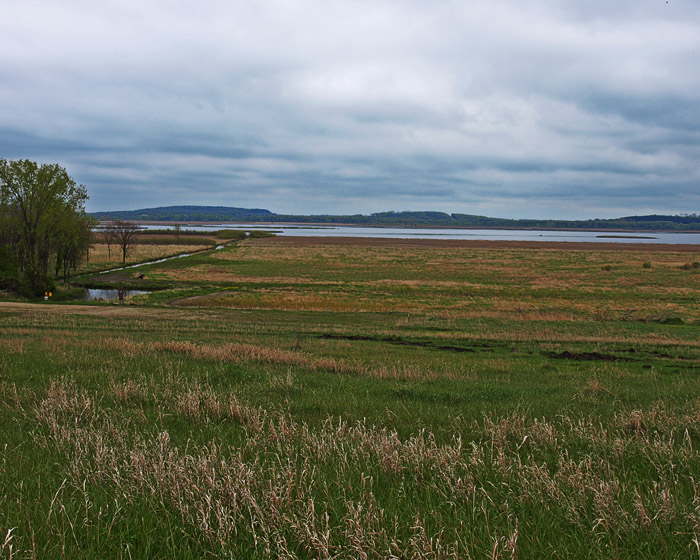
- Grand River Marsh view from inlet of Grand River and an old drainage channel.
-

- Michigan Lily, often mistaken for Turks Cap Lily, growing along road side of Grand River Marsh Wildlife Refuge.
-

- Swamp Milkweed
-
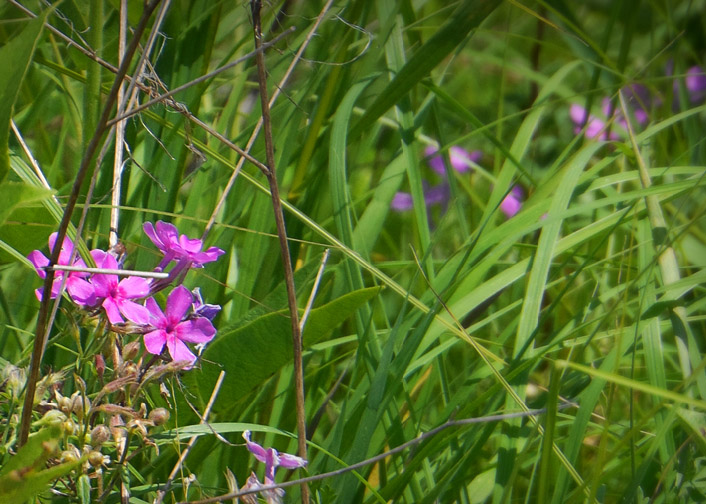
- A hot pink wild Phlox growing in Grand River Marsh Wildlife Refuge.
-

- Two dead trees remain upright among the marsh grass
-
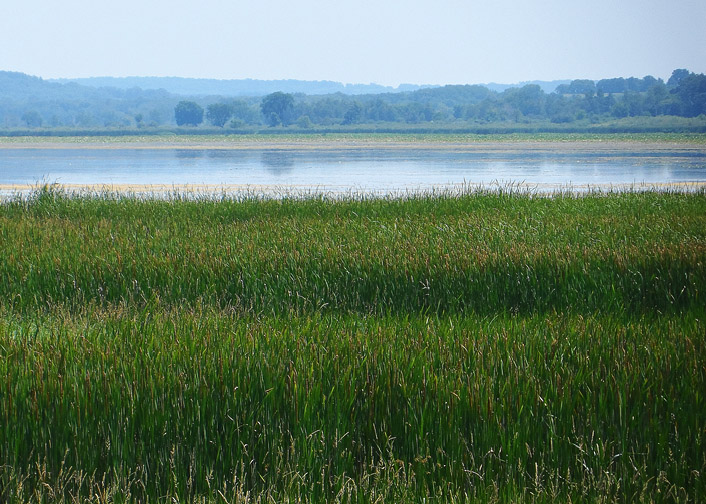
- The Grand River flows through marsh grass towards the low dam on the Wisconsin wildlife refuge.
-
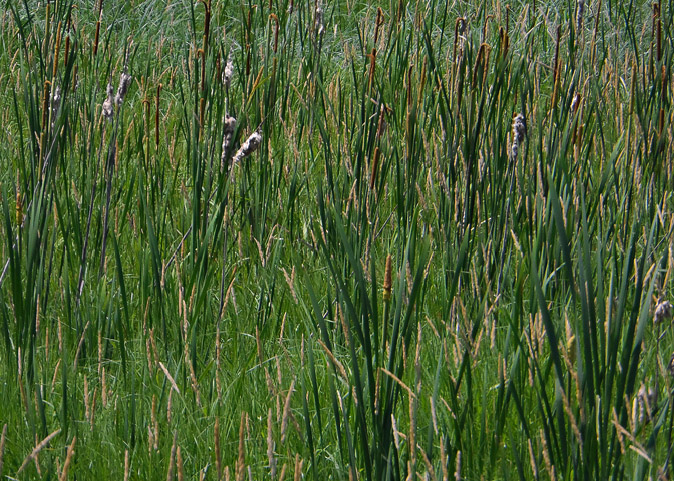
- Cattails of new year and last season on Grand River Marsh, Wisconsin wildlife refuge
-

- Cattails
-

- Landscape of Grand River Marsh Wildlife Refuge from the dam end
-

- Golden Alexander
-
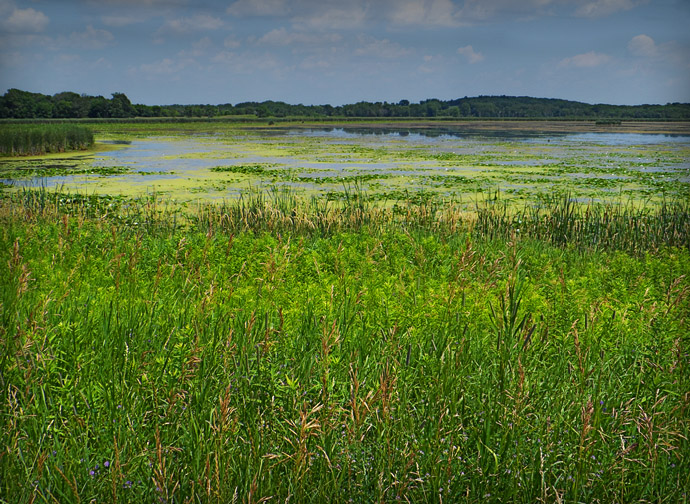
- View of Grand River Marsh from the dam end of the Wisconsin Wildlife Refuge
I know that bungling through wildlife areas and marshes behind the wheel of a car makes about as much sense as exploring the Arctic Ocean wearing a bikini while skateboarding. Neither process is going to actually get me up close or down into range of smelling wild roses. Nature areas, by design, keep people at a distance to protect native habitats and the birds, mammals and fish that allow for seasonal exploration, hunting and fishing opportunities for the bit of nature lover or cave dweller among us.
The paradox of nature areas is that if not for hunters, there would be no protected and restored areas to visit now. Approximately seventy-five years ago, the great sportsmen’s clubs started to realize their opulent lifestyle was disappearing. These were men with money, big business owners and politicians. Luckily, they also had foresight and the ability to organize, plan, and purchase properties that had been ill-suited for anything but marginal farming.
These groups eventually became dozens of citizen’s action organizations and land protection agencies. In Wisconsin, we now have a great diversity of public lands for recreational activities. By purpose or accident, the planners of these areas also ignored accessibility to prime viewing areas and zones by anyone unable to hike in. The exception is that All Terrain Vehicles are often permitted during hunting season. Preserved areas, therefore, become available only to the physically able. And I’m not very capable or trusting of my abilities to walk very far anymore. I’m in a place where a great many citizens find themselves nowadays, viewing nature from a distance, looking for small signs of movement, blurs, flashes of colors or the very rare, but lucky roadside view. I explore with greatly limited access.
Forget access roads, few exist in Wisconsin nature areas. I’m lucky if I can find a place to park a single car. I gave up looking for marked trails. I hiked many a deer trail only to find no view at the end. Whitetail don’t give a bleat about the view beyond dinner service between their agile hooves. The areas that show trails on their maps probably haven’t been maintained for many years. I found rows of full-grown trees and fence line weaving in and out of what should have been clearly marked trail.
Grand River Marsh Wildlife Area is 7,000 acres located mostly in Green Lake and a small portion in Marquette County, Wisconsin. Not a long drive via map, however the only roads in are also the only roads out so it’s necessary to repeat yourself to get home.
Hubby was home on vacation and he promised me a road trip. Road trip to me is, follow me into the wetlands and no complaining, okay?
“No problem, will I be back in time to run the Path of Exile race at 3 pm?”
My watch read a little after 11 am so I nodded yes with confidence. I didn’t feel there was any need to speak since he probably wouldn’t hear me anyway. He still had his computer headphones on and the sound cranked up.
I gathered up my trusty Wisconsin Southern Coverage All-outdoors Atlas and Field Guide by Sportsman’s Connection. I love this spiral bound wish book of all the places I want to drive to and manage to find my way out of. It’s my version of hitchhiking through Europe and a great African Safari. Will I really get lost or will I manage to find my way home. I don’t have a GPS or a smart phone. Just my Atlas, a standard compass and dumb ass cell phone that pings off every other cell tower like an electronic billboard with a new message from my provider. The big wave of the future will be the mass flushing of cell phones.
“Here we go surfing now, everybody’s surfing now…” I’m bobble-heading while sitting in the car waiting for hubby.
The car console contains water bottle, mine, big honking green energy drink, hubby’s, two cell phones, binoculars, camera, two sets of car keys, Atlas, we are ready to launch the little Kia Spectra on a new adventure.
Still buckling his seat belt, “You sure you know where you’re going?”
I try to arch my left eyebrow but the weight of the neck wrinkles win the pull of gravity and all I manage is a slow upward slide of my eyes.
“Duh, yeah …but be prepared, it’s going to be a long drive,” I reminded him.
“So kay, no problem, did you bring my camera?”
We’re already on the highway. “No…I asked if you wanted ‘YOUR’ camera because remember, you’re responsible for bringing ‘YOUR’ camera along,” I repeated for the twentieth time on the twentieth road trip.
“Damn, I hate your camera, useless thing!”
“Well, I’m not too fond of it either, but it fit’s better than the full size one for this kind of trip. We can always take video if we get lucky and see any White Birds.”
About then I’d driven down County Highway B and entered Green Lake County. I was always surprised when I drove south and east and found myself in Green Lake County. I regularly drove north by east to get to the same county to get to my boarded horse. I did mention we would be driving in a big loop with no exit. This is about the time my thinking gets, well, constipated, and I have to pull over to the side of the road and check the map again. I feel topsy-turvy, but I’m actually just south of normal, if there is such as thing as normal for me.
We’re into Amish country now, but surprised that no buggies are on the road. Don is trying to note where any Amish stores are, clearly disappointed they’re not open. The Amish stores sell yummy baked goods and in season have the finest honey in the area. All the head rotations a lapsed Southern Baptist can pull off still won’t open an Amish bakery on a Thursday.
I’ve turned off Highway B and onto Highway H. It’s a pretty drive, through wooded glades and curves reminiscent of times past when this was a summer resort area for the less than wealthy. Only a couple of campgrounds remain in the area now, tucked between the narrow, sluggish Grand River and much larger but equally shallow Lake Puckaway.
It’s been a while since I’ve been out this way and I missed the turn, even though hubby pointed out the weather tattered ‘Wedding’ sign hanging under the mailbox. I suspect that sign was placed there long before Estella left. A half-mile up the road I realize I’m looking at potato fields and Havisham’s corner was the turn.
Google Space Map was a fresco painted of forgiveness, use, abuse, repair, poor patching, making do and attempts to improve land for the use of the public. Eighteen reclaimed farms spread across my computer screen like faded wallpaper in an abandoned farmhouse parlor, half the roof gone, still a faint pattern after decades of sunlight and storm exposure. Amid the scabs of field edges previous scars of mounds and effigies left by people who inhabited the region prior to the farmers. Today’s field trip is edging close to a time trail of Native Peoples, failed farmers, hunters, conservationists, and day-trippers. The alterations to these lands will take generations to erase.
I’ve finally reached Grand River Road and I surge along between 30 and 5 knots, steering over a white-water of potholes washing under the poorly maintained road. As Commander of the wee imaginary bumper boat, Spectra, I’m weaving off one side of the road, down the center, and off-center again. Slowing for yet another pitfall, I glance at my husband and notice his love handles take longer to rise than fall. I tilt sharply to the right to avoid another rut.
“HOLE,” yells hubby as both hands fly up and clutch his seat belt to his heart.
My pretend bumper boat flips to a stop as the left side of my head pinged off the window like a moth against a porch light. Of course, now an oncoming truck is approaching and a second one is moving up behind us. Not another car on the road until we find the possible entrance to the River Styx and a nanosecond to breath deeply and plunge axle deep and rise on a swell of gratitude with tires intact on the other side. I pull off to the side of the road while both trucks roll up what’s left of the broken concrete and take their individual piece of hell with them.
We’re at one of the pools where I enjoy stopping to swatch a wide variety of birds. Today nothing is happening. Hubby has the binoculars and he’s thrilled to spot a Grebe diving on the pond. We both make a full sweep of the sky and adjacent area just in case a Whooping Crane might be in the about but nothing is hovering except dragonflies.
Farther along the road I hear, “Joe Pye Weed!”
A minute later, “ Look, Turk’s Cap Lilies!
“Did you see the pink Swamp Milkweed?” I asked. He’d missed that. I puzzled over his ability to identify Joe Pye Weed.
Eventually, the ‘improved road’ ended and we continued to the end of the drive on a nice flat graded gravel road. I loved the sound of crunching under the wheels, reminding me of an entire theater full of moviegoers chowing down of fresh, hot, buttered popcorn. When we ran out of road we found the gate to the dam open. Unaware if there was parking down the access road we played if safe and parked at the road head and walked in. The view from the dam end of the marsh was lovely, a soft haze resting upon the horizon. A golf cart clattered past us, six family members hanging on to various handles and uprights. They pulled in and turned around at the dam and realized that our walking was our exercise for the week.
Reaching the spillway, we found the family, grandfather, son, oldest grandson, probably a preteen, and a couple of preschoolers, a boy and girl. Both preschoolers were wearing sandals as they romped over the gravel and rocks looking for insects and critters in the marsh grasses. The girl dressed for dinner out, a black sequined top dress with a sheer nylon skirt. Any fashionista posing for paparazzi would look stunning in it.
She ran up to us while her brother sailed into the cattails. “What are you looking for,” she boldly inquired.
“Elephants…” replied my husband.
POKE … indentation meets love handle.
“What!” he exclaimed. “Could be, why let her down.”
I looked at her puzzled face just before she ran off behind her sidekick. They turned and charged back down the slope.
“Please be careful, I don’t want you to fall and hurt yourself on the rocks,” I asked her, concerned for her safety.
“Oh let her be, it’ll heal by the time she gets married,” my husband mumbled.
I couldn’t help it. I smiled.
The closest to wildlife we’d encountered were the deep resounding burps of a couple of frogs while walking the path to the dam. It was disappointing not to find birds of any type. We started the walk back to the car.
“You are a Whooping Crane,” my husband told me, “you’ve got long legs.”
“Yeah, I know – and a beak,” I reminded him.
“But wait,” he said, “you’ve got red hair.”
“… and you’re a white chick!”

 The Road Less Paved